Online ammonium monitoring in cooling water and wastewater is done with continuous analyzers based on three main principles: gas-sensitive or ion-selective electrodes, colorimetric (photometric) chemistry, and gas stripping with conductivity detection. The right choice depends on the measuring range, the sample matrix, the acceptable maintenance effort and the reagents the site is prepared to handle. This guide from Akan Industrial and Automation explains each principle and the selection criteria, and shows where the PAI AMX ammonium analyzer fits.
Why monitor ammonium online?
Ammonium is present in nature only in trace amounts, but in industrial water systems it is an indicator of process leaks, contamination or biological activity. Its general toxicity is low, yet it is a serious threat to fish, so discharge limits for effluent are usually strict.
Typical reasons to measure continuously rather than by grab sample:
- Cooling water – detecting ingress of ammonia or ammonium-containing process streams through heat exchanger leaks, and supporting cooling water treatment control.
- Industrial effluent – demonstrating compliance with discharge permits and catching upsets before they reach the outfall.
- Wastewater treatment plants – controlling nitrification and aeration, where ammonium at the inlet and outlet of the biological stage is a key control variable.
How is ammonium measured online?
All common methods exploit the equilibrium between ammonium (NH₄⁺) and dissolved ammonia (NH₃). At neutral pH most of the nitrogen is present as NH₄⁺; at strongly alkaline pH it shifts almost entirely to NH₃, which can be sensed as a gas or stripped out of the sample.
Gas-sensitive and ion-selective electrodes
A gas-sensitive ammonia electrode sits behind a gas-permeable membrane. The sample is made alkaline, NH₃ diffuses through the membrane and changes the pH of an internal electrolyte, which the electrode measures. An ammonium ion-selective electrode (ISE) responds directly to NH₄⁺ in the sample, but can be affected by other cations such as potassium, so it is best suited to samples with a known, stable composition.
Electrode methods are compact and fast and cover a wide range. Their limitations are electrode drift, membrane fouling and the need for regular calibration. Analyzers such as the PAI ISE Analyzer/Titrator reduce matrix effects by using standard addition instead of direct potentiometry when the sample contains interfering compounds.
Colorimetric (photometric) methods
Colorimetric analyzers mix a measured sample volume with reagents that form a coloured compound with ammonium; the absorbance at a defined wavelength is proportional to concentration. Indophenol blue (Berthelot) and salicylate chemistry are widely used variants.
Photometry is selective and can reach low levels, but turbidity and natural colour in the sample can interfere, so filtration and compensation are often needed. Reagents have a limited shelf life and must be prepared and replaced regularly. The PAI Process Colorimeter PCA uses two-wavelength optics with turbidity and temperature compensation for nutrients including ammonium.
Gas stripping with conductivity detection
In the stripping method, sodium hydroxide raises the sample pH, the released ammonia is stripped from the sample and absorbed into deionized water, and the resulting increase in conductivity is measured. Because the detection takes place in clean water rather than in the sample, particles, turbidity and colour do not reach the detector. This is the principle used by the PAI AMX.
How do the methods compare?
| Criterion | Gas-sensitive electrode / ISE | Colorimetric (photometric) | Gas stripping + conductivity |
|---|---|---|---|
| Detection principle | Potential change at membrane electrode | Absorbance of a coloured complex | Conductivity increase of deionized water after NH₃ absorption |
| Effect of turbidity and colour | Low to moderate; membrane fouling possible | Can interfere; filtration or compensation needed | Matrix separated from detector by stripping |
| Interferences | Other cations (ISE); volatile amines (gas-sensing) | Depends on chemistry and matrix | Other volatile bases may contribute; application-dependent |
| Reagents | Alkali, calibration standards | Colour reagents with limited shelf life | Dilute sodium hydroxide (AMX) |
| Drift and calibration | Electrode drift; frequent calibration typical | Moderate; depends on reagent condition | Low drift for the AMX |
| Typical strengths | Compact, fast, wide range | Selective, well-established chemistry | Difficult matrices, low detection limits |
The ranges and detection limits achievable with each method vary by manufacturer and configuration, so compare actual data sheets for the duty rather than generic figures.
What should you check when selecting an ammonium analyzer?
Measuring range and detection limit
Define the normal, upset and alarm concentrations. Cooling water leak detection usually needs a low detection limit to see a small leak early, while influent monitoring at a treatment plant needs a high upper range. Some analyzers cover both by automatic dilution or configurable ranges; check whether one instrument can cover the full span or whether two ranges are needed.
Sample matrix
Collect information on suspended solids, colour, oil, temperature, hardness, biocides and other dissolved species. Hardness can cause scaling when the sample is made alkaline, and oil or biofilm can foul membranes and optical cells. The matrix often decides the principle more than the range does.
Response time and number of points
Batch analyzers measure in cycles of several minutes. If one analyzer serves several sample points through a multiplexer, each point is measured less often. Check that the resulting update rate is fast enough for the alarm or control function.
Reagents and consumables
List every reagent, its consumption, shelf life, storage needs and safety data. Reagents that age can be a source of measurement error if they are not replaced on time.
Maintenance and calibration
Ask for the routine maintenance tasks, their frequency and the skills required: electrode and membrane replacement, tubing, pump heads, cleaning, ion exchanger resin. Automatic cleaning and automatic calibration or validation reduce operator workload.
Sample conditioning
Most measurement problems in online water analysis come from the sample system, not the analyzer. Consider sample take-off location, transport lag, temperature, filtration or settling, fast loops and drain routing. The sample conditioning should be designed together with the analyzer selection, not afterwards.
Integration
Confirm outputs (4–20 mA, alarm contacts, fieldbus), the data needed in the DCS or SCADA, and whether an audit trail is required for regulatory reporting.
Where does the PAI AMX fit?
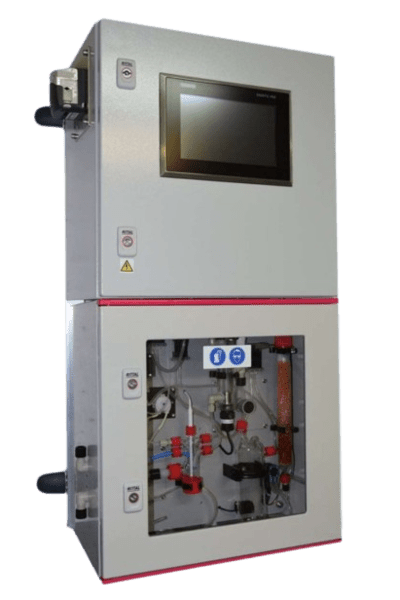
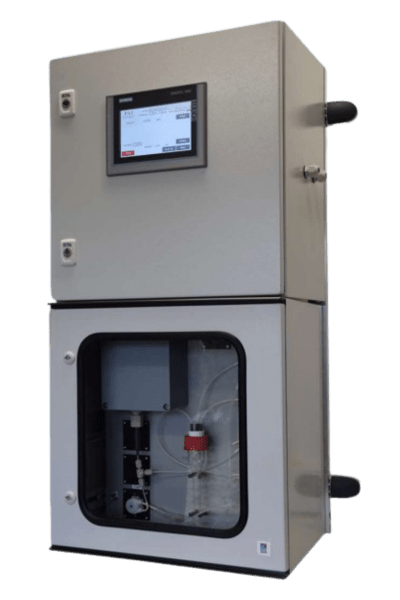
The PAI AMX uses gas stripping with conductivity detection and is designed for cooling water, industrial wastewater and wastewater treatment plants. Facts relevant to selection:
| Selection point | PAI AMX |
|---|---|
| Measuring range | Below 10 ppb to above 10,000 ppm, depending on configuration |
| Detection limit | Below 10 µg/l (ppb), configuration dependent |
| Sample pretreatment | Not needed in most applications; filtration recommended for heavily polluted wastewater |
| Matrix effects | Particles, turbidity and colour do not interfere |
| Reagents | Only dilute sodium hydroxide; no ageing colour reagents |
| Measuring interval | 5–10 minutes typical; 30-second response version available |
| Cleaning | Automatic stripper cleaning at user-set intervals |
| Sample streams | Up to 8 with optional multiplexer |
| Sample temperature | 0–30 °C |
| Communication | 4–20 mA, alarm contacts; Modbus TCP and Profibus as options |
The AMX is a strong candidate where the sample is turbid, coloured or variable, where a low detection limit is needed for leak detection, or where the site wants to avoid handling colour reagents. Where the matrix is clean and a different set of ions must also be measured, an ISE analyzer may be a more economical choice; where several nutrients or metals are measured by one instrument, a colorimeter may fit better. The final choice should be made against the actual sample data.
How Akan can help
Akan Industrial and Automation supplies PAI liquid analyzers in Türkiye and engineers the complete measuring point: analyzer specification, sample system design from sample tap to analyzer, cabinet or shelter integration, DCS interfacing, FAT/SAT and start-up support. See our analytical instrumentation services, online analyzer systems and water and wastewater industry page, or contact us with your sample data to discuss a suitable ammonium analyzer.