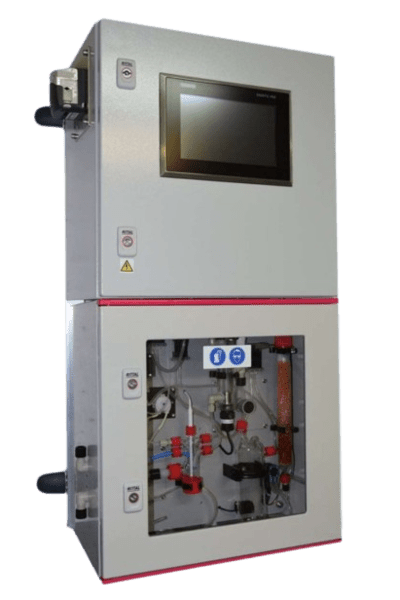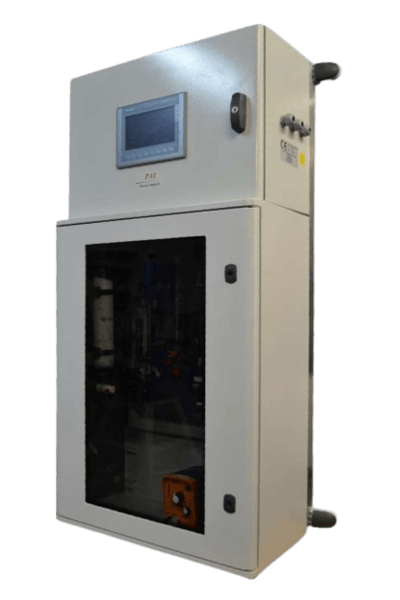
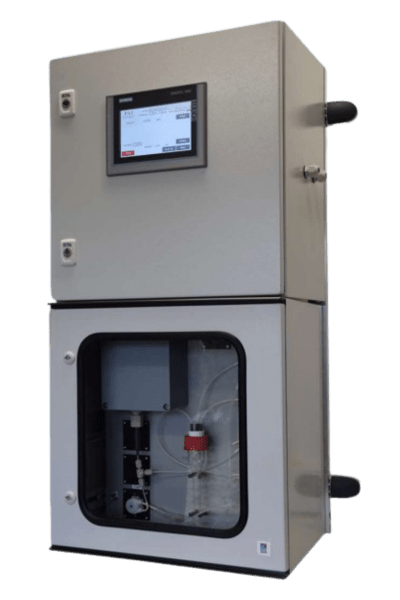
The PAI Process Colorimeter PCA (Process Colorimetric Analyser) is an online photometric analyzer that can be configured for almost any colorimetric method – heavy metals, nutrients such as phosphate and ammonium, and organic compounds. It compensates automatically for sample temperature and turbidity and measures up to four channels with one instrument. Akan Industrial and Automation supplies the PCA in Türkiye and engineers the sampling and integration around it.
What is a process colorimeter used for?
Many industrial processes need reliable online control of critical parameters, and environmental regulations set discharge limits for a growing number of substances. The PCA was designed for this: a flexible instrument that runs 24/7 and is robust not only in hardware but also in its analytical method, tolerating changes in sample colour, turbidity, temperature and matrix.
How the PCA works
- Temperature compensation – sample and air temperatures are measured and their effect on the colour reaction is corrected automatically.
- Turbidity compensation – either a sample blank is run in each measurement, or absorbance is measured at a second wavelength and corrected mathematically.
- Two-wavelength photometer – two LEDs allow two parameters per instrument, or one parameter with turbidity correction.
- Wide range – measuring cells from 1 mm to 3 cm path length; very high concentrations via automatic dilution up to 1:1000.
- Automatic calibration – blank and span are measured at set intervals; if drift exceeds a limit, an alarm is raised and the last valid calibration stays in use.
- Automatic cleaning – after each measurement, at set intervals, and for back-flushing of optional filtration modules.
- Data storage – up to 1000 time-stamped results, downloadable via RS232.
Key specifications
| Parameter | Value |
|---|---|
| Method | Colorimetric / photometric |
| Measuring range | Configuration and application dependent |
| Measuring interval | 15–30 min, application dependent |
| Optics | Two-wavelength photometer (LED) |
| Channels | Up to 4 |
| Alarms | Threshold, system fault (potential-free, NC/NO) |
| Status signal | Remote control (potential-free) |
| Analog outputs | Up to 4 × 4–20 mA, galvanically isolated, max. 500 Ω |
| Digital inputs | Remote control |
| Data interface | RS232; memory for 1000 results |
| Housing | Wall-mounted; powder-coated steel (electronics, IP55), plastic (hydraulics) |
| Dimensions (W × D × H) | approx. 400 × 250 × 800 mm |
| Weight | approx. 30 kg |
Why choose Akan for colorimetric analysis?
Akan works with you to define the method, sample conditioning and filtration, then delivers the analyzer installed, integrated and commissioned. Related: ISE Analyzer/Titrator, water and wastewater industry and analytical instrumentation services.