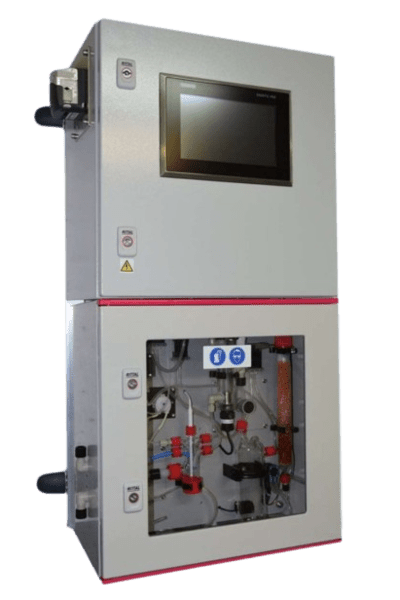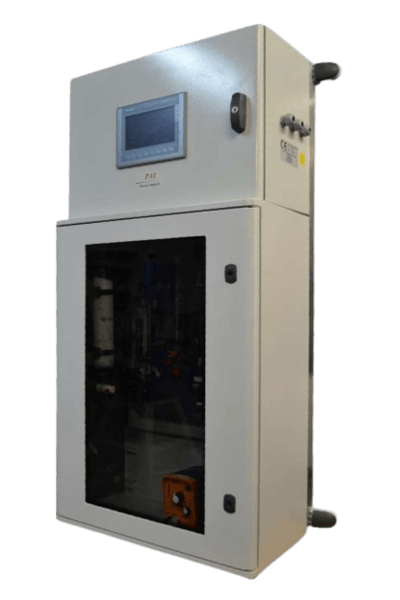
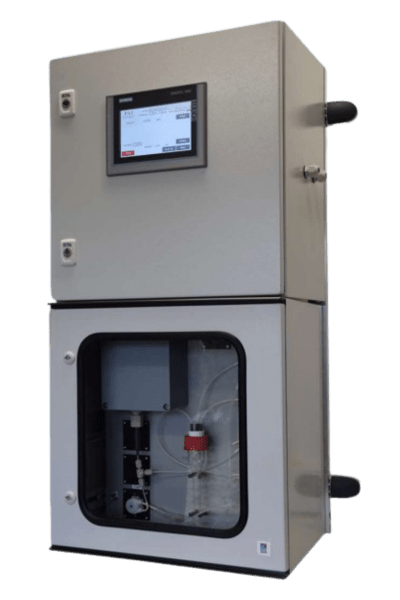
The PAI ISE Analyzer/Titrator is an online potentiometric analyzer that uses ion-selective electrodes (ISE) to measure ions such as ammonium, chloride, fluoride, cyanide and sulphate in process water and wastewater. Depending on the sample matrix, it works by direct potentiometry, standard addition or titration. Akan Industrial and Automation supplies the instrument in Türkiye and engineers the complete measuring point around it.
What can the ISE Analyzer measure?
The potential between an ion-selective electrode and a reference electrode depends on the concentration of the target ion – the pH electrode is the best-known example. The ISE Analyzer/Titrator uses this principle for:
- Ammonium (NH₄⁺)
- Bromide (Br⁻), chloride (Cl⁻), fluoride (F⁻), iodide (I⁻)
- Cyanide (CN⁻)
- Nitrate (NO₃⁻)
- Potassium (K⁺)
- Sulphide (S²⁻), sulphate (SO₄²⁻)
- Alkalinity and acidity (m/p value)
How it works: three analytical methods
| Method | Principle | When to use |
|---|---|---|
| Direct potentiometry | The potential between ISE and reference electrode is converted to concentration with the Nernst equation | Samples free of interfering ions and complexing agents |
| Standard addition | Known standard additions are measured; concentration is calculated by linear regression | Samples with an excess of a compound that reacts with the analyte |
| Titration | The electrode potential (or absorbance, with a photometer) detects the titration end point | Low detection limits or difficult matrices |
Key specifications
| Parameter | Value |
|---|---|
| Analytical methods | Potentiometry, photometry, standard addition, titration |
| Measuring range | Application dependent |
| Measuring interval | 5–30 min (typical) |
| Channels | Up to 8 |
| Sensors | Ion-selective, pH or redox electrode; photometer (application dependent) |
| Alarms | Threshold, system fault (potential-free, NC/NO) |
| Status signal | Remote start/stop (potential-free, optional) |
| Analog outputs | Up to 8 × (0)4–20 mA, max. 500 Ω |
| Digital inputs | Start/stop and others |
| Dimensions (W × D × H) | approx. 400 × 270 × 910 mm |
| Weight | approx. 30 kg |
Options
- Automatic cell and line cleaning
- Automatic filtration and filter cleaning
- Automatic calibration and/or validation
- Multiplexer for up to 8 channels
A separate brochure for the titrator version is available: Titrator brochure (PDF).
Why choose Akan for ion analysis?
Akan selects the right method and electrode set for your sample, designs the sample conditioning and integrates the analyzer into your control system. Learn more about our analytical instrumentation services, or see the AMX ammonium analyzer for reagent-free ammonium monitoring.