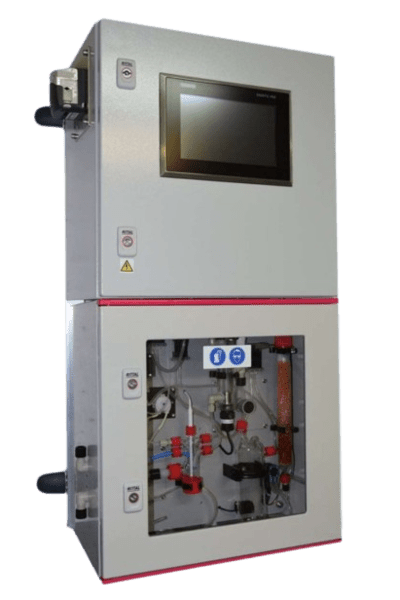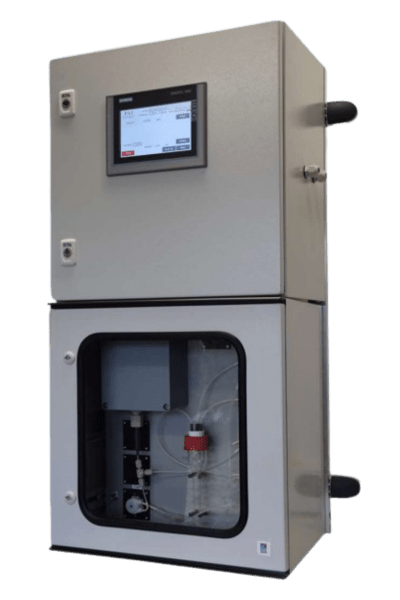
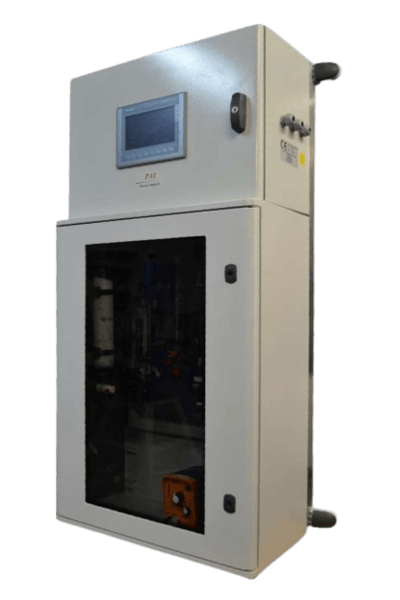
The PAI PAIPOX Monitor is an online analyzer for purgeable (volatile) organic halogens (POX) in wastewater and cooling water. It strips halogenated compounds from the sample, decomposes them by UV radiation and measures the released halide ions potentiometrically, so turbidity, colour and pH do not affect the result. Akan Industrial and Automation supplies the PAIPOX in Türkiye together with sample system engineering and commissioning support.
What is the PAIPOX Monitor used for?
Halogenated organic compounds are widely used in the chemical industry as solvents, intermediates and products, and most are harmful to people and the environment. The PAIPOX Monitor is mainly used to monitor wastewater and cooling water in chemical processes – for example, to detect heat-exchanger leaks into cooling water. It also works in heavily polluted wastewater with a high VOC load.
How the POX measurement works
- Purgeable organic compounds are stripped from the sample and transferred into a stream of demineralized water.
- A UV-initiated reaction decomposes the organic compounds.
- The resulting halide ions are measured potentiometrically.
- The POX concentration is calculated from a calibration curve.
Typical detectable compounds include dichloromethane, vinyl chloride, chloroform, dichloropropane, tetrachloromethane, chlorobenzene, dichloroethane, trichloroethane, tetrachloroethane, dichloroethene and trichloroethene.
Key specifications
| Parameter | Value |
|---|---|
| Method | Potentiometric determination after UV digestion |
| Measuring interval | Continuous, T90 approx. 5 min |
| Channels | Up to 8 |
| Sample | Unpressurized, integrated pump; 10–20 l/h; 0–30 °C (higher with optional sample cooler) |
| Detector | Potentiometric (2 electrodes); NDIR optional |
| Alarms | Fault, maintenance request (potential-free, NC/NO); threshold (optional) |
| Analog outputs | Up to 8 × (0)4–20 mA, galvanically isolated, max. 500 Ω |
| Digital input | Start/stop etc. (optional) |
| Communication | Ethernet; Profibus and Modbus optional |
| Ambient conditions | Indoor; 10–40 °C; 5–95 % RH, non-condensing |
| Housing | Wall-mounted; powder-coated steel upper part, fibre-reinforced polyester lower part. ATEX: stainless steel / GRP with PU foam insulation |
| Dimensions (W × H × D) | 600 × 1180 × 350 mm (non-ATEX) |
| Weight | approx. 60 kg |
| Power supply | 95–264 V AC, 45–65 Hz, 100 W |
| Instrument air | Dry, oil-free (optional, for corrosive atmospheres and ATEX) |
Operation and maintenance
- A 7” touch panel shows results (numeric and graphic), errors and maintenance requests; menus are password-protected and multi-channel values are shown per channel.
- All functions are monitored continuously. Faults trigger an alarm, a text message and an entry in the event memory.
- UV lamp life and demineralized water quality are monitored; maintenance needs are signalled on screen and optionally via a digital output.
- Users can carry out all maintenance without special tools.
Options
- Multiplexer for up to 8 channels
- Detection of purgeable brominated compounds
- Detection of non-halogenated organic compounds (VOC)
- Filtration systems and in-situ stripper
- Profibus, Modbus
- ATEX version
- Audit trail
Why choose Akan for POX monitoring?
Akan handles analyzer specification, sample conditioning, cabinet or shelter integration and DCS interfacing as part of our analytical instrumentation services. For broader VOC monitoring in water, see the Organic X Monitor HC.