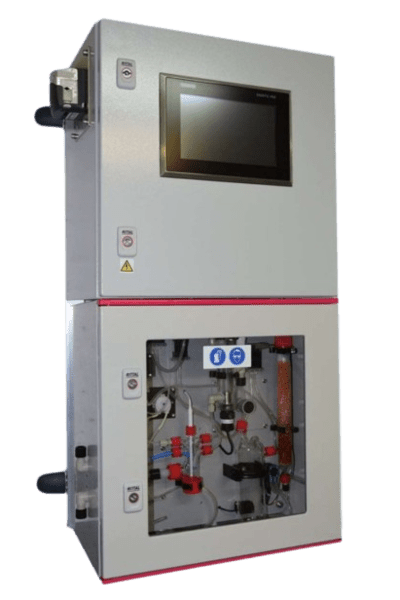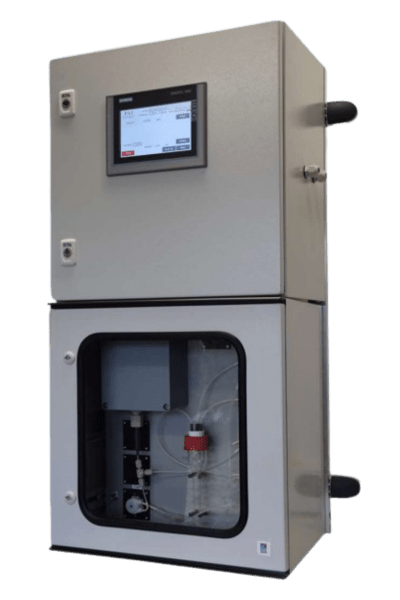
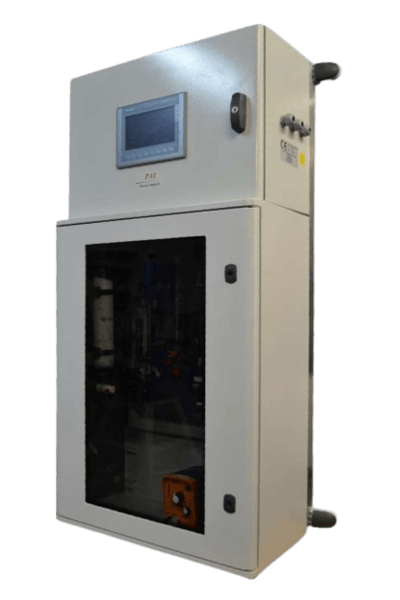
The PAI Organic X Monitor HC (OXM HC) is an online analyzer for purgeable and volatile organic compounds (POC/VOC) in water, including fuels, BTEX and volatile halogenated hydrocarbons. It combines air stripping, UV digestion and conductivity detection to reach detection limits below 1 ppb for some compounds, without reagents. Akan Industrial and Automation supplies the OXM HC – listed on our former website as the “VOC-Analyser” – and integrates it into complete monitoring systems.
What is the Organic X Monitor HC used for?
Detecting organic compounds in water is one of the most common tasks in process and environmental monitoring. Alongside total organic carbon (TOC), operators measure dissolved organic carbon (DOC) and volatile organic carbon (VOC). The OXM HC focuses on the volatile fraction – typical uses are leak detection in cooling water, effluent monitoring and protection of downstream treatment stages.
How the VOC measurement works
The analyzer uses the patented Degussa method:
- A stream of clean air strips volatile organic compounds from the sample.
- The compounds are dissolved in pure water.
- UV radiation decomposes them into inorganic ionic species.
- The conductivity increase is measured and converted to concentration.
Detectable compounds include BTEX (benzene, toluene, xylene), styrene, naphthalene, indene, hexane, butadiene, methanol, 2-propanol, dichloromethane, vinyl chloride, chloroform, dichloropropane, tetrachloromethane, chlorobenzene, dichloroethane, trichloroethane, tetrachloroethane, dichloroethene, trichloroethene and fuels.
Key specifications
| Parameter | Value |
|---|---|
| Analytical method | Conductivity after UV digestion; ion-selective (optional) |
| Measuring range | Configuration dependent |
| Measuring interval | Continuous, T90 1–5 min |
| Detection limits (examples) | Perchloroethylene 0.5 µg/l; diesel 10 µg/l; naphthalene 20 µg/l |
| Alarms | Threshold (optional), system fault, maintenance request (potential-free, NC/NO) |
| Status signal | Remote control (potential-free, optional) |
| Analog outputs | Up to 8 × (0)4–20 mA, galvanically isolated, max. 500 Ω |
| Communication | Ethernet; Profibus and Modbus optional |
| Housing | Wall-mounted; powder-coated steel (electronics, IP55), plastic (hydraulics) |
| Dimensions (D × W × H) | 35 × 61 × 121 cm |
| Weight | approx. 60 kg |
Reliability and maintenance
The instrument and the analytical method are robust. Routine maintenance and part replacement are quick and done by the user, so factory maintenance or service contracts are not required. The modular design allows the configuration to be changed easily when the application changes.
Options
- Multiplexer for up to 8 channels
- Audit trail
- Modbus TCP, Profibus
- Sm@rt Server remote access
Why choose Akan for VOC monitoring in water?
Akan defines the measuring task, selects the configuration with the manufacturer and delivers the complete measuring point – sample system, cabinet and DCS integration. See also the PAIPOX Monitor for halogen-specific monitoring and our analytical instrumentation services.