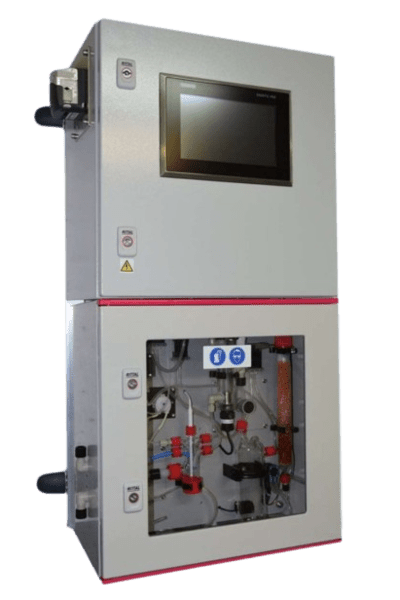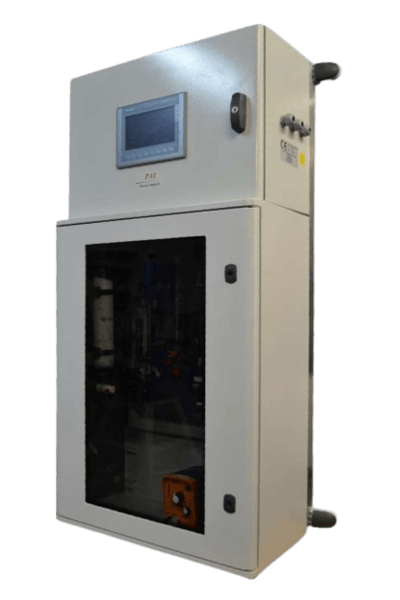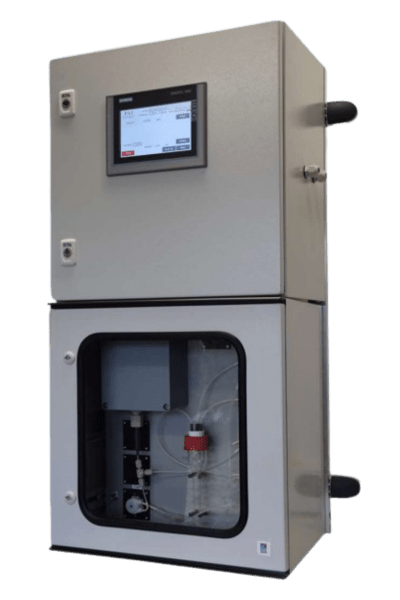
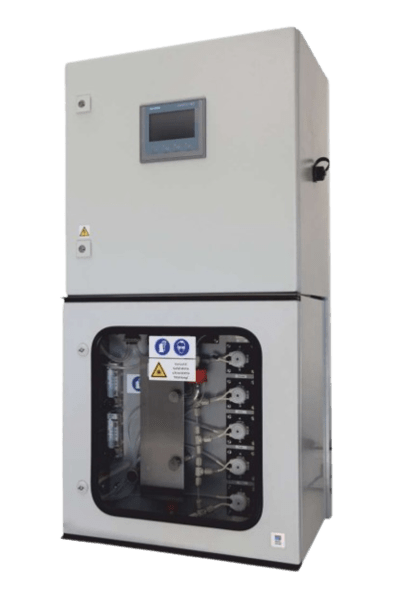
The PAI PAITOC is an online total organic carbon (TOC) analyzer for wastewater, cooling water and potable water. It converts organic carbon to CO₂ by UV/persulfate digestion and measures it with an NDIR detector, covering ranges from 0–100 ppm up to 0–10,000 ppm. Akan Industrial and Automation supplies the PAITOC (also sold as “TOC-Analyser PAITOC”) in Türkiye, including sample filtration, integration and commissioning support.
Why measure TOC online?
Organic compounds are among the most important pollutants in water: they affect biochemical processes, nutrient cycles and biological availability. TOC is the standard sum parameter for organic load, used to monitor effluent, detect product losses into cooling water and control treatment processes.
How the PAITOC TOC analyzer works
- The sample is acidified and inorganic carbon (TIC) is purged out.
- The sample is transferred into the UV reactor and sodium persulfate is dosed.
- Intensive UV radiation drives a radical digestion of the organic compounds to CO₂ for a user-adjustable time.
- The CO₂ is stripped and measured by an NDIR detector.
The batch takes about 10 minutes for most applications; the measuring interval is user-adjustable.
Key specifications
| Parameter | Value |
|---|---|
| Measuring principle | NDIR after UV/persulfate digestion |
| Ranges | 0–100, 0–500, 0–1000, 0–5000, 0–10,000 ppm (others on request) |
| Measuring interval | > 15 min, adjustable |
| Calibration | Manual; automatic calibration or validation (option) |
| Reproducibility | ± 5 % of full scale |
| Drift | < 5 % of full scale in 72 h without calibration at 20 °C |
| Sample | Atmospheric, built-in pump; 0–40 °C; particles up to 200 µm |
| Reagents | Sodium persulfate; nitric acid (or phosphoric acid) |
| Power supply | 85–264 V AC, 45–65 Hz, 100 W |
| Analog outputs | Up to 8 × (0)4–20 mA, galvanically isolated |
| Alarms | System fault, maintenance request (potential-free, NC/NO) |
| Display | 7” TFT touch panel |
| Housing (H × W × D) | 1000 × 500 × 340 mm; IP65 powder-coated steel upper part, IP44 GRP lower part, polycarbonate window |
| Fire protection | According to UL 94-V0 |
| Weight | approx. 42 kg |
| Ambient conditions | 0–50 °C; 95 % RH, non-condensing |
Operation, maintenance and running costs
- Electronics and hydraulics sit in separate compartments.
- Results, alarms and maintenance messages are stored on an SD card; menus are password-protected.
- An automatic cleaning system keeps the instrument clean, and the operator can carry out all maintenance.
- Reagent use per measurement: 1.5 ml of 1 M sodium peroxodisulfate and 1.5 ml of 5 % nitric acid – approx. 10 ct per measurement.
- All wetted parts of the optional filtration unit are PVC and stainless steel; back-flushing is controlled by the analyzer or a separate controller.
Options
- Automatic calibration and validation – alarms if results fall outside user-defined limits.
- Multiplexer – up to 8 sample streams per analyzer.
- Additional digital I/O – e.g. remote start/stop.
Why choose Akan for TOC monitoring?
Akan engineers the full measuring point – sample tap, filtration, analyzer cabinet or shelter, and DCS connection – and supports FAT, SAT and start-up. Related: water and wastewater industry, Organic X Monitor LC for condensate, and online analyzer systems.